Walk into any online store selling “natural oils” and you will see essential oil, absolute oil, attar, and fragrance oil sitting side by side, often at wildly different prices, with almost no explanation of why. Many buyers assume they are all versions of the same thing, just marketed differently. They are not.
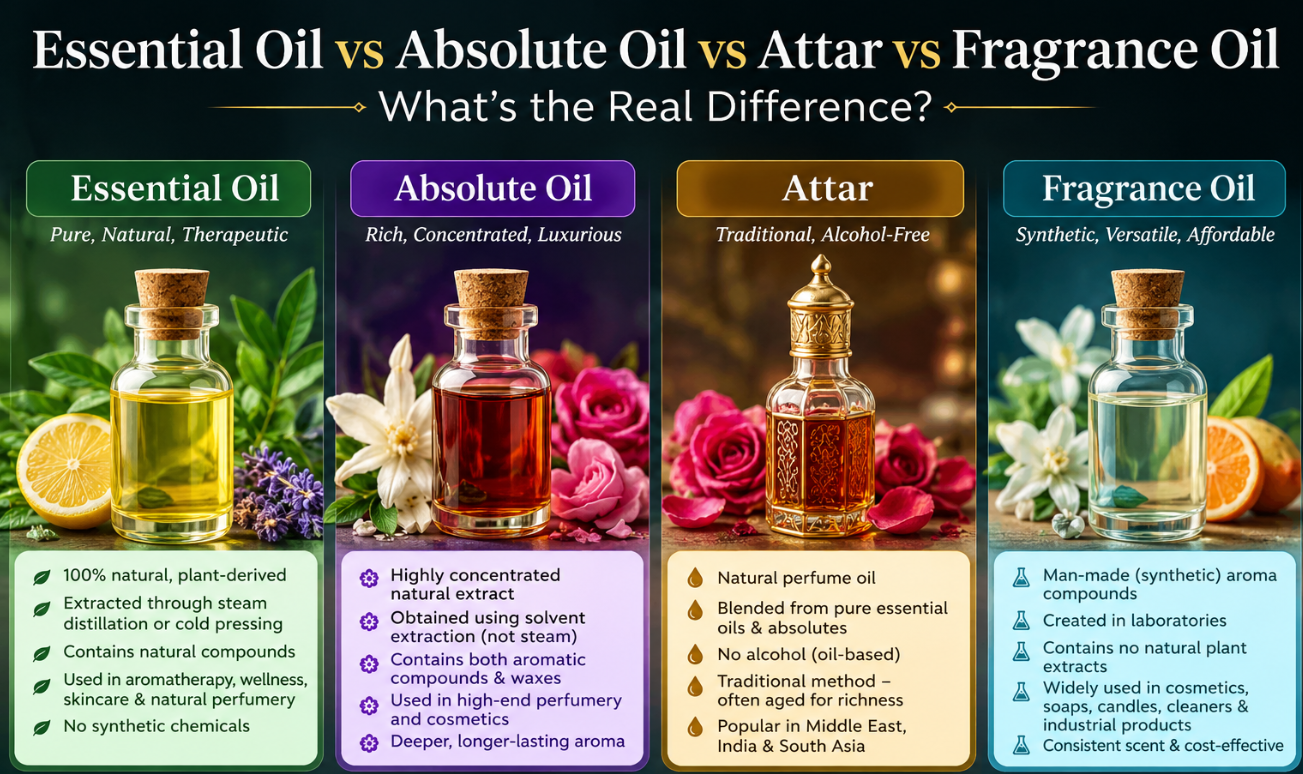
Short answer: An essential oil is a concentrated aromatic extract obtained directly from a plant, usually through distillation or expression. An absolute is a highly aromatic plant extract, typically produced through solvent extraction, used mainly in fine perfumery. A traditional attar (also spelled ittar or itr) is a finished, oil-based fragrance rooted in South Asian and Middle Eastern perfumery traditions, historically made by distilling botanicals into a base such as sandalwood oil. A fragrance oil is a formulated fragrance composition that may combine synthetic aroma chemicals, natural isolates, essential oils, or absolutes, blended to achieve a specific scent and performance.
None of these four is simply a “stronger” or “weaker” version of another. They come from different processes, serve different purposes, and belong in different parts of your fragrance, skincare, candle, or perfumery project. This guide breaks down exactly how, so you can choose the right material with confidence.
Essential Oil vs Absolute vs Attar vs Fragrance Oil: Quick Comparison
| Essential Oil | Absolute Oil | Attar / Ittar / Itr | Fragrance Oil | |
| What it is | Concentrated aromatic plant extract | Highly aromatic plant extract | Traditional oil-based perfume or botanical distillate | Formulated fragrance composition |
| Source | Single plant material | Usually delicate plant material | Botanicals, often set in a base oil | Natural and/or synthetic aromatic materials |
| Extraction method | Steam distillation, hydrodistillation, or cold expression | Solvent extraction, producing a concrete that is refined into an absolute | Traditional distillation (deg-bhapka) or modern formulation | Blending and compounding |
| Natural vs synthetic | Naturally derived | Naturally derived | Traditionally natural, though modern versions vary | Can be either, or a blend of both |
| Typical composition | Volatile aromatic compounds only | Volatile compounds plus some non-volatile waxes and pigments | Aromatic distillate combined with a carrier such as sandalwood oil | Custom blend of aroma chemicals and/or naturals |
| Aroma character | True-to-plant, often sharper or “greener” | Rich, deep, close to the living flower | Warm, often musky or woody due to the base | Wide range, designed for a specific scent profile |
| Common uses | Aromatherapy, natural perfumery, cosmetics | Fine perfumery, high-end fragrance blending | Personal fragrance, religious and cultural use | Candles, soap, cosmetics, perfumes, home fragrance |
| Skin use | Requires dilution in a carrier oil | Requires dilution, used mainly by perfumers | Traditionally worn directly, in small amounts | Depends entirely on the specific formulation |
| Relative cost | Varies widely by plant | Often expensive due to yield and process | Varies with ingredients and craftsmanship | Generally more affordable and consistent |
| Main advantage | Pure, single-origin aromatic material | Captures delicate florals distillation cannot | Cultural heritage, alcohol-free, long wear | Unlimited scent variety, consistent output |
| Main limitation | Some plants yield very little oil | Can be costly and harder to source | Not standardized; quality varies by maker | Not automatically natural or automatically synthetic |
A Note About Terminology
The words “essential oil,” “absolute,” “attar,” “perfume oil,” and “fragrance oil” are often used loosely, and sometimes interchangeably, in online stores. In this guide, we use them in their technical, perfumery sense, and we point out where everyday commercial usage differs from the traditional meaning. Understanding this distinction will help you buy the right material for your actual purpose, whether that is aromatherapy, natural perfumery, candle making, or traditional attar collecting.
Essential Oil, Absolute, Attar, Ittar, Itr, Perfume Oil and Fragrance Oil: What’s What?
Before going deeper, here is a simple semantic map that sums up how these terms relate to one another:
- Essential oil – a raw aromatic extract taken directly from a plant.
- Absolute – a solvent-extracted aromatic plant material, typically richer and closer to the living flower’s scent.
- Attar / Ittar / Itr – regionally rooted terms for a traditional, oil-based finished perfume, historically distilled into a natural base.
- Perfume oil – a general commercial term for an oil-format fragrance; it may or may not qualify as a true attar.
- Fragrance oil – a formulated fragrance composition built from natural and/or synthetic aromatic materials.
One more source of confusion is the word “oil” itself. Not every oil is the same kind of material. Essential oil, carrier oil, absolute, attar, perfume oil, fragrance oil, infused oil, and fixed oil are all different concepts, even though they share a common word. Keeping this map in mind makes the rest of this guide much easier to follow.
What Is an Essential Oil?
An essential oil is a concentrated aromatic extract obtained from a single plant source through a physical extraction process such as steam distillation, hydrodistillation, or cold expression. It captures the volatile aromatic compounds naturally present in the plant’s flowers, leaves, bark, roots, or peel, without adding solvents or synthetic materials to the finished oil.
How Are Essential Oils Made?
Most essential oils are extracted using one of these methods:
- Steam distillation: Steam passes through plant material, carrying volatile aromatic compounds with it. The vapor is then cooled and condensed, separating the essential oil from the water (hydrosol).
- Hydrodistillation: The plant material is boiled directly in water, useful for tougher botanicals like roots and woods.
- Cold expression: Used mainly for citrus peels, where the oil is mechanically pressed out without heat.
The choice of method depends on the plant’s structure and how heat-sensitive its aromatic compounds are.
What Makes an Essential Oil Different?
An essential oil is a single-source, unblended aromatic extract. It has not been diluted, altered with solvents, or combined with other fragrance materials during extraction. Its aroma profile reflects the specific plant, harvest, and extraction conditions, which is why essential oils from the same plant species can smell slightly different depending on origin, climate, and distillation practice.
Examples of Common Essential Oils
Lavender, peppermint, eucalyptus, tea tree, rose, sandalwood, vetiver, frankincense, and bergamot are among the most widely used essential oils, valued across aromatherapy, skincare formulation, and natural perfumery.
What Is an Absolute Oil?
The absolute oil is a highly aromatic plant extract, most commonly produced through solvent extraction rather than steam distillation. Delicate flowers such as jasmine, tuberose, and lotus are often too fragile for heat-based distillation, or they simply do not yield enough essential oil to be commercially practical. Solvent extraction solves both problems, producing a material that captures scent notes distillation alone often cannot reach.
How Are Absolutes Made?
The process typically follows this path: plant material is washed with a solvent to dissolve its aromatic and waxy compounds, producing a solid, waxy substance called a concrete. The concrete is then treated with ethanol, which separates out the aromatic portion from the waxes. After filtration and evaporation of the ethanol, what remains is the absolute, a concentrated, deeply fragrant liquid.
This is why absolutes are considered particularly useful for delicate or heat-sensitive plant material, and for botanicals that produce very little essential oil through conventional distillation.
Essential Oil vs Absolute: What’s the Difference?
The most meaningful difference is not simply concentration, but extraction method and resulting composition. Essential oils are produced through distillation or expression and contain only volatile compounds. Absolutes are produced through solvent extraction and can retain trace waxes, pigments, and other non-volatile plant material alongside the aromatic compounds, giving them a deeper, richer, more “true to the flower” character.
Why Are Some Flowers Better Suited to Absolutes?
Flowers like jasmine and tuberose continue producing fragrance compounds even after being picked, and their scent molecules can be damaged or altered by the heat used in steam distillation. Solvent extraction works at lower temperatures, preserving these more fragile aromatic notes.
Why Are Absolutes Often More Expensive?
Absolutes typically require large quantities of raw flowers, labor-intensive hand harvesting, and a multi-step extraction process. Combined with lower yields per kilogram of plant material, this makes absolutes some of the most expensive materials in natural perfumery.
Popular Absolutes
Jasmine absolute, rose absolute, tuberose absolute, lotus absolute, vanilla absolute, oakmoss absolute, violet leaf absolute, and champaca absolute are widely used by perfumers seeking depth and realism that distillation alone struggles to achieve. Explore our Floral Absolute Oil collection to see the full range.
What Is Attar, Ittar or Itr?
Attar, also spelled ittar or itr depending on region and language, refers to a traditional oil-based perfume rooted in South Asian and Middle Eastern perfumery. Unlike essential oils and absolutes, which are raw aromatic materials used as ingredients, a traditional attar is typically a finished fragrance product, ready to wear.
What Does Attar Mean?
The word attar (from the Persian/Arabic “itr,” meaning perfume) traditionally refers to a natural perfume created by distilling aromatic botanicals into a base carrier oil, most classically sandalwood oil. Over centuries, attar making developed into a distinct craft, especially in regions such as Kannauj in India, historically known as one of the centers of traditional attar production.
How Traditional Indian Attar Is Made
Classical Indian attar production uses a traditional distillation method known as deg-bhapka. Aromatic plant material, such as rose petals or agarwood chips, is placed in a copper still (deg) along with water. As it is heated, the vapor travels through a bamboo pipe into a receiving vessel (bhapka) that already contains a base oil, typically sandalwood oil. The vapor condenses directly into the base oil, gradually infusing it with fragrance. The resulting attar is then matured, sometimes for months, to allow the scent to develop fully.
What Makes Indian Attar Different?
Because it is distilled directly into an oil base rather than isolated and bottled on its own, a traditional attar is a complete, wearable fragrance from the moment it is finished, not a raw material waiting to be blended by someone else.
Indian Attar vs Middle Eastern Attar
The meaning of attar varies somewhat by region and tradition, and it is worth being precise here rather than making a blanket claim. In South Asian perfumery, the term is strongly associated with traditional botanical distillation into a base such as sandalwood oil. In Middle Eastern fragrance culture, “attar” is often used more broadly to describe oil-based perfume compositions in general, which may or may not follow the classical distillation method. Both traditions share a long history of oil-based, alcohol-free perfumery, but the production methods and terminology are not perfectly identical.
Is Attar the Same as Essential Oil?
No. An essential oil is a raw, single-plant aromatic extract used as an ingredient. A traditional attar is a finished perfume, typically made from multiple aromatic sources distilled into a carrier oil, and intended to be worn directly. Treating “attar” as simply another name for essential oil overlooks the fact that attar making is a distinct craft with its own base, blending, and maturation process.
Is Attar the Same as Perfume Oil?
Not always. The terms overlap heavily in commercial use, and many products sold as “perfume oil” are marketed as attars. However, not every oil-based perfume qualifies as an attar in the traditional sense, since true attar making follows specific regional methods and materials. In everyday retail language the two terms are often used interchangeably, but perfumers and traditional attar makers generally treat “attar” as a more specific, heritage-rooted category. Browse our Indian Attar collection for classic options such as sandalwood, mitti, oud, and rose attar.
What Is Fragrance Oil?
A fragrance oil is a formulated fragrance composition, blended to achieve a specific scent and performance for a particular application, such as candles, soap, cosmetics, or perfumery. It is best understood not as a single raw material, but as a designed mixture that may contain synthetic aroma chemicals, natural aromatic isolates, essential oils, absolutes, or combinations of all of these, depending on how it was formulated.
Are Fragrance Oils Synthetic?
Not necessarily, and this is one of the most common misconceptions in the industry. A widespread but oversimplified claim states that essential oils are always natural while fragrance oils are always synthetic. In reality, a fragrance oil is defined by its purpose as a formulated blend, not by whether every ingredient in it is synthetic. Many fragrance oils are built using a mix of natural and synthetic components chosen for scent accuracy, stability, and performance in the finished product.
Natural Fragrance Oil vs Synthetic Fragrance Oil
Some fragrance oils are formulated primarily or entirely from naturally derived aromatic materials, including essential oils and absolutes. Others rely more heavily on synthetic aroma chemicals to achieve scents that would be difficult, unstable, or impossible to source naturally, such as “rain,” “clean linen,” or certain fruit accords. Neither approach is automatically superior; the right choice depends on the intended use, budget, and desired scent complexity.
Why Are Fragrance Oils So Widely Used?
Fragrance oils are popular in candle making, soap making, home fragrance, cosmetics, and personal care because they offer a nearly unlimited range of scent profiles, consistent batch-to-batch performance, and often a lower cost compared to rare naturals. For applications that require a very specific, repeatable scent identity, a well-formulated fragrance oil is often the most practical choice.
Essential Oil vs Absolute Oil
The core distinction lies in extraction and composition rather than “strength.” Essential oils are produced through distillation or expression and contain only the plant’s volatile aromatic compounds. Absolutes are produced through solvent extraction and can carry additional non-volatile material along with the aromatics, giving them a heavier, more true-to-life floral character. Absolutes also tend to work well for plants that are poorly suited to distillation, while essential oils remain the standard for a much wider range of botanicals, including herbs, woods, and citrus peels. In perfumery, both are valued as natural raw materials, but they are rarely interchangeable for a given plant, since not every plant is commercially produced as both.
Essential Oil vs Attar
Essential oil is a raw aromatic ingredient. Traditional attar is a finished, oil-based fragrance product. An essential oil on its own is not typically worn as a finished perfume; it is usually diluted, blended, or used in aromatherapy and formulation. A traditional attar, by contrast, is created specifically to be worn as a complete fragrance, distilled directly into a base oil and matured before it reaches the consumer. This is the single most important distinction between the two, and it is where a lot of online content gets it wrong by treating attar as just another word for essential oil.
Essential Oil vs Fragrance Oil
This is likely the most searched comparison of the four, and it deserves a precise answer rather than a simplistic one. Essential oils are naturally derived, single-source aromatic extracts. Fragrance oils are formulated compositions that may include natural and/or synthetic materials, designed for a specific scent and application. The difference is not “natural versus synthetic” in every case; it is “single-source raw material versus engineered blend.”
In practice, this affects several things:
- Scent variety: Fragrance oils can replicate scents that do not exist in nature, such as many gourmand or “fresh linen” accords, which essential oils cannot do.
- Consistency: Fragrance oils are formulated to a fixed recipe, so batch-to-batch scent stays consistent. Essential oils can vary slightly by harvest, climate, and origin.
- Cost: Fragrance oils are often more affordable, especially compared to rare essential oils with low extraction yields.
- Application suitability: Not every fragrance oil is approved for skin contact, and not every essential oil is approved for candle wax at high concentrations. Always check the supplier’s documentation for the specific intended use.
- Aromatherapy claims: Fragrance oils are not typically used for aromatherapy in the same sense as essential oils, since aromatherapy relies on naturally occurring plant compounds.
Neither option is universally “better.” The right one depends entirely on whether your goal is a natural, plant-derived aromatic ingredient or a precisely engineered scent for a specific product.
Absolute Oil vs Attar
This comparison is less commonly discussed, but it highlights an important conceptual point: an absolute is a raw perfumery ingredient, while a traditional attar is a finished fragrance product. A perfumer might use rose absolute as one component within a larger fragrance formulation, alongside dozens of other materials. A traditional attar maker, on the other hand, is creating the finished product itself, distilling botanicals directly into a base oil to produce something ready to wear. Both can showcase incredibly rich, true-to-plant aromas, but they occupy different roles in the fragrance world, one as an ingredient, the other as a craft-made finished perfume.
Attar vs Fragrance Oil
Traditional attar is rooted in centuries-old distillation methods and regional craftsmanship, typically made with natural botanicals distilled into a base oil. Fragrance oil is a modern, formulated blend, engineered for a specific scent profile and often produced for large-scale commercial use across candles, soap, cosmetics, and personal fragrance. Attar tends to carry cultural and heritage value along with a distinctive, warm, oil-based wear on skin, while fragrance oil offers far greater scent variety and consistency for manufacturing purposes. Someone seeking a traditional, alcohol-free personal fragrance with cultural roots will likely lean toward attar, while someone formulating candles or soap at scale will typically reach for a fragrance oil suited to that application.
Fragrance Oil vs Perfume Oil: Are They the Same?
Often, yes, but not always precisely. In everyday commercial language, “fragrance oil” and “perfume oil” are frequently used interchangeably, along with terms like “perfume oil concentrate” and “scent oil.” Strictly speaking, “fragrance oil” tends to describe a formulated composition used across many applications, including candles and soap, while “perfume oil” more often refers to a fragrance oil specifically designed and diluted for wear on skin. The exact terminology used by a brand or supplier depends on their industry and intended application, so it is always worth checking the product description for the actual intended use rather than relying on the name alone.
Which One Should You Choose?
There is no single “best” option among essential oil, absolute, attar, and fragrance oil. Essential oils and absolutes are raw aromatic materials. Traditional attar is a finished, wearable perfume. Fragrance oil is a formulated composition built for a specific application. The right choice depends entirely on what you are trying to make or use.
| Your Goal | Best Starting Point |
| Aromatherapy | Essential oil |
| Natural perfumery | Essential oil / absolute |
| Floral fine perfumery | Absolute |
| Traditional Indian or Middle Eastern personal fragrance | Attar |
| Oil-based, alcohol-free perfume | Attar / perfume oil |
| Candle making | Fragrance oil approved for candle use |
| Soap making | Fragrance oil approved for cold-process or hot-process soap |
| Maximum scent variety | Fragrance oil |
| Recreating complex modern fragrance profiles | Fragrance oil / formulated composition |
| Traditional botanical fragrance with cultural heritage | Attar |
Choose Essential Oil If…
You want a single-source, naturally derived aromatic extract for aromatherapy, natural skincare formulation, or as a raw material in natural perfumery.
Choose Absolute If…
You are formulating fine perfumery and need the rich, true-to-flower depth of botanicals like jasmine, rose, or tuberose that distillation alone cannot fully capture.
Choose Traditional Attar If…
You want a finished, oil-based, alcohol-free personal fragrance with cultural and traditional roots, ready to wear directly.
Choose Fragrance Oil If…
You need a wide variety of scent options, consistent performance across batches, and a material specifically formulated and approved for candles, soap, cosmetics, or other manufactured products.
A word of caution: always check a supplier’s documentation for the specific intended use and any usage restrictions, since actual safe use levels depend on the individual material and the finished product it is going into, not on which of these four broad categories it belongs to.
Are Essential Oils, Absolutes, Attars and Fragrance Oils Safe?
Safety depends on the specific material, its concentration, and how it is used, not simply on whether it is labeled “natural” or “synthetic.” This is an important point, because a lot of commercial content assumes natural automatically means safe, which is not accurate.
A few key considerations apply across all four categories:
- Dilution matters. Concentrated aromatic materials, whether essential oils, absolutes, or attars, are generally intended to be diluted before skin contact, not applied undiluted in large amounts.
- Sensitization and allergens. Certain naturally occurring compounds found in essential oils and absolutes, as well as some synthetic aroma chemicals used in fragrance oils, are recognized fragrance allergens and can cause skin irritation or sensitization in some individuals.
- Phototoxicity. Some essential oils, particularly certain citrus oils, can increase skin sensitivity to sunlight and are not recommended before sun exposure.
- Intended application matters. A material approved for use in a diffuser is not automatically approved for direct skin contact or for use in candle wax, and vice versa. Always check the supplier’s documentation for the specific intended use.
- Regulatory bodies exist for a reason. Organizations such as the International Fragrance Association (IFRA) publish standards that can prohibit, restrict, or set conditions for the use of specific fragrance materials, including natural complex substances like essential oils, based on safety assessments for particular applications. Regulatory agencies such as the US FDA have also clarified that being plant-derived does not automatically exempt an ingredient from safety or regulatory considerations in cosmetics and personal care products.
- “Pure” does not mean “safe to apply directly.” A pure, unadulterated essential oil, absolute, or attar can still cause irritation or an allergic reaction if applied undiluted or used in excessive amounts.
In short, treat concentration and correct usage as the primary safety factors, and always follow supplier guidance and recognized industry standards for the specific application you have in mind.
Common Myths About Essential Oils, Absolutes, Attars and Fragrance Oils
Myth 1: Fragrance oils are always synthetic. Not true. Many fragrance oils are formulated using a combination of natural and synthetic materials, or in some cases largely natural ones, depending on the formulation.
Myth 2: Essential oils are always safer because they are natural. Not true. Natural origin does not automatically mean an ingredient is free of irritation, sensitization, or phototoxicity risk. Safety depends on the specific material, concentration, and use.
Myth 3: Attar and essential oil are the same thing. Not true. Essential oil is a raw ingredient. Traditional attar is a finished, oil-based perfume, typically made by distilling botanicals into a base such as sandalwood oil.
Myth 4: Absolute oil is just a stronger essential oil. Not true. The defining difference is the extraction method and resulting composition, solvent extraction versus distillation, not simply strength or concentration.
Myth 5: All perfume oils are attars. Not true. The terms overlap in casual commercial use, but a true attar generally follows specific traditional production methods and materials, while “perfume oil” is a broader, less precise term.
Myth 6: More concentrated automatically means better. Not true. Concentration should match the intended use. Over-concentrated materials used incorrectly can increase the risk of irritation without improving the outcome.
Myth 7: A “pure” oil can automatically be applied directly to skin. Not true. Purity refers to the absence of adulteration, not automatic suitability for undiluted skin application. Dilution guidance should always be followed.
Myth 8: Synthetic fragrance ingredients are inherently unsafe. Not true. Safety is determined by ingredient-specific assessment and appropriate use levels, not by whether a material is natural or synthetic in origin.
Essential Oil vs Absolute vs Attar vs Fragrance Oil: Final Verdict
Essential oils and absolutes are raw aromatic materials extracted directly from plants, essential oils through distillation or expression, and absolutes through solvent extraction for more delicate botanicals. Traditional attar is a finished, oil-based perfume rooted in South Asian and Middle Eastern craftsmanship, historically distilled into a natural base like sandalwood oil and worn as a complete fragrance. Fragrance oil is a formulated fragrance composition, built from natural and/or synthetic aromatic materials and designed for a specific scent and application, from candles and soap to cosmetics and perfumery.
None of these four materials is a substitute for another, and none is universally superior. The right choice comes down to your actual purpose: aromatherapy and natural formulation point toward essential oils, fine floral perfumery points toward absolutes, traditional wearable fragrance points toward attar, and consistent, application-specific scent design points toward fragrance oil. Understanding these distinctions, rather than treating “oil” as one interchangeable category, is the difference between choosing the right material the first time and guessing.
Frequently Asked Questions
What is the difference between essential oil and fragrance oil?
Essential oil is a naturally derived, single-source aromatic extract from a plant. Fragrance oil is a formulated fragrance composition that may include natural and/or synthetic materials, designed for a specific scent and application.
What is the difference between essential oil and absolute oil?
Essential oil is produced through distillation or expression. Absolute oil is produced through solvent extraction, which suits delicate flowers that distillation cannot process well, resulting in a richer, more true-to-flower aroma.
Is attar the same as essential oil?
No. Essential oil is a raw aromatic ingredient, while traditional attar is a finished, oil-based perfume, typically distilled into a base oil and worn directly.
Is attar the same as perfume oil?
Not always. The terms are often used interchangeably in retail, but a true attar generally follows traditional production methods, while “perfume oil” is a broader commercial term.
What is an absolute oil?
An absolute is a highly aromatic plant extract, typically produced through solvent extraction, valued in fine perfumery for capturing delicate floral notes that distillation cannot fully preserve.
How is absolute oil made?
Plant material is washed with a solvent to produce a waxy concrete, which is then treated with ethanol and filtered to separate and concentrate the aromatic compounds, resulting in the absolute.
Are fragrance oils natural or synthetic?
It depends on the formulation. Fragrance oils can be made with synthetic aroma chemicals, natural materials, or a combination of both.
Are fragrance oils safe for skin?
Only fragrance oils specifically formulated and labeled as suitable for skin use should be applied to skin, and always according to the recommended dilution and usage guidance.
Are essential oils better than fragrance oils?
Neither is universally better. Essential oils suit aromatherapy and natural formulation, while fragrance oils suit applications needing a specific, consistent, or complex scent profile not achievable naturally.
Which lasts longer, essential oil or fragrance oil?
This varies by specific material and formulation rather than by category. Some essential oils, like sandalwood or vetiver, have excellent longevity, while some fragrance oils are engineered specifically for long wear or throw.
Which is better for perfume, essential oil or fragrance oil?
Natural perfumers often favor essential oils and absolutes for authenticity, while commercial and creative perfumery frequently uses fragrance oils for scent range and consistency. Many perfumes actually combine both.
Which is better for candles, essential oils or fragrance oils?
Fragrance oils formulated and tested specifically for candle use are generally preferred, since they are designed to perform well and remain stable at melting temperatures, which not all essential oils are suited for.
Can you use absolute oils in perfume?
Yes. Absolutes are widely used as premium raw materials in fine perfumery, particularly for floral notes like jasmine, rose, and tuberose.
What is the difference between attar and perfume?
Attar traditionally refers to an oil-based, alcohol-free fragrance rooted in South Asian and Middle Eastern craftsmanship. “Perfume” is a broader general term that also includes alcohol-based eau de parfum and eau de toilette formats.
What is the difference between attar and fragrance oil?
Attar is a traditional, oil-based finished fragrance with cultural and historical roots. Fragrance oil is a modern, formulated composition designed for a wide range of commercial applications.
What is the difference between ittar and attar?
There is no functional difference; ittar and attar are regional spelling variants of the same term, referring to traditional oil-based perfume.
What is itr perfume?
Itr is another spelling variant of attar, referring to the same category of traditional, oil-based perfume common in South Asian and Middle Eastern fragrance culture.
Why are absolutes more expensive?
Absolutes require large quantities of raw, often hand-harvested flowers and a multi-step extraction process with relatively low yield, which drives up their cost compared to many essential oils.
Are essential oils always safer than fragrance oils?
No. Safety depends on the specific material, its concentration, and how it is used, not simply on whether it is labeled natural or synthetic.
Which oil is best for natural perfumery?
Essential oils and absolutes are the standard raw materials for natural perfumery, since they are derived directly from plant sources without synthetic aroma chemicals.